



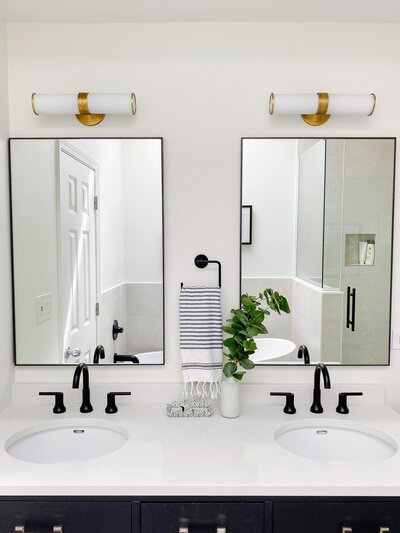
AI has officially made its way into the interior design conversation, and well… every conversation. At first, I mostly heard designers talking about how we could use it behind the scenes to run our businesses more efficiently. Now, clients and friends are bringing it up too. They’re using AI to test ideas, generate rooms, and help make design decisions in their own homes.
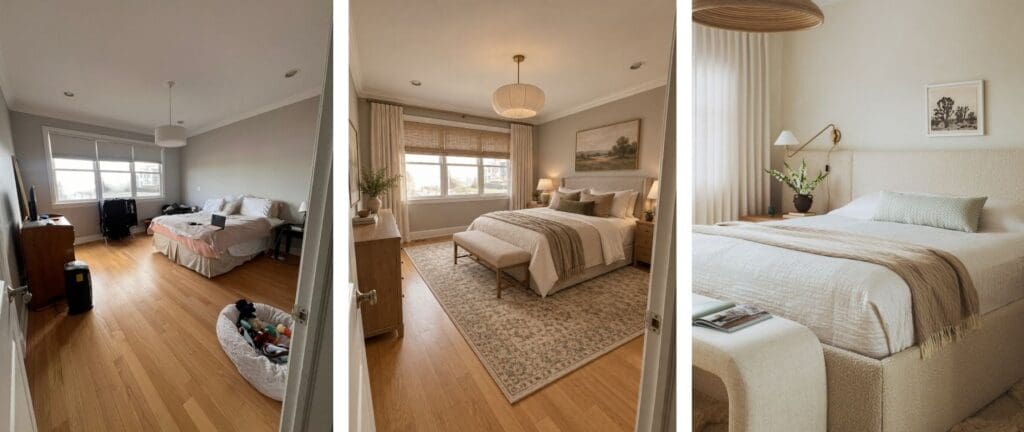
I get the appeal. You can upload a photo of a room and, within seconds, see a completely different version of it. To the untrained eye, it can look pretty convincing. There’s furniture, lighting, art, color, and suddenly the space feels “finished.”
But a finished image and a finished room are two very different things. I think AI has its place, but it also has a few downfalls…

Where AI Can Be Helpful
I actually think AI has the potential to be a great starting point for creativity. As designers, we speak one language and our clients often speak another. Someone may tell me they want a “modern” room, then show me images that are warm, layered, traditional, and colorful. My job isn’t to correct their terminology. It’s to understand what they’re responding to and translate that into a home that feels personal to them.
AI can help with that early exploration. If you’re having trouble articulating what you want a room to feel like, generating a few ideas may help you get there. Maybe you discover you’re drawn to more pattern than you thought, or that you really love darker walls, or that what you were calling “minimal” is actually just calm and collected.
That is useful information. We just have to be careful not to confuse it with a design plan.
What AI Can’t See
The biggest thing AI misses is every single thing happening underneath the pretty image. Scale, functionality, existing conditions, quality, budget, construction, installation, and the hundreds of small decisions required to actually make a room work.
Our Lincoln Park project is a great example.

In the image above, you can’t tell that the windows behind the sofa tilt and hinge open. As a result, the window treatments had to work around the way the windows physically operate. We worked with our drapery workroom to figure out the right construction and installation.
This home also has concrete ceilings, which meant we couldn’t simply add ceiling lighting wherever we wanted. We had to create a lighting plan using the walls and floor lamps instead. And it didn’t stop us from getting creative with the ceiling…

My point is, AI would never know those things. And even if you prompted it? It’s not going to give you the best solutions.
Those constraints exist at every scale. A rendering might show a gorgeous patterned tile in a bathroom, but it isn’t necessarily considering where the pattern should start, what happens at the edges, how it transitions into the next material, whether the scale works in the room, or if the material is even appropriate for the application.
Sometimes the details are even less glamorous. We recently replaced door hardware for a client and had to reorder part of it because the strike plate wasn’t right. Door hardware sounds pretty simple… until you’re considering how the door swings, the existing conditions, the handle style, the finish, and all the little pieces required to make it function properly. Not exactly the sexy side of design, but very much part of the job.

The Problem With a Perfect AI-Designed Room
AI also has a funny habit of making what I call “executive creative decisions.” You ask it to change the wallpaper and suddenly the railing is different. You finally get the sofa right and now the window has moved or disappeared entirely. The image may look beautiful, but at a certain point it stops representing the actual room. Have you experienced this?

We’ve played with AI for quick visual studies, and I do think there is value there. Sometimes I want to see how wallpaper might look in a certain staircase or quickly communicate a general idea. But if I need precision, I still want a human rendering partner who understands exactly what stays, what changes, and what has to work in real life.
The other challenge is that AI makes the end result look incredibly easy. You generate a beautiful room in ten seconds, but it doesn’t show you the process of getting there. Where does that sofa come from? Is it the right size? Is it comfortable? Will it fit through the doorway? What fabric should you use? What happens if it arrives damaged? Where should you splurge and where can you save?
Every item in a room has layers of decisions underneath it. That is where professional guidance becomes incredibly valuable.
Preserving The Human-Side of Design
This is also where my mind starts wandering into slightly conspiracy-theory territory. If AI eventually gives us a complete room and then provides links to buy everything in it, how are those products being chosen? Are they truly the best fit for your space, or are they the brands paying to show up in searches?
Designers spend years finding makers, craftspeople, vintage dealers, showrooms, and sources that aren’t always going to appear at the top of a search result. Those relationships are part of what makes a home feel layered and personal.
I also wonder what happens creatively if AI keeps learning from the same popular imagery and generating versions of it over and over again. Do our homes slowly become more alike? We’ve already lived through eras where everyone seemed to have the same gray sofa, white kitchen, and greige walls. I’m not particularly interested in going back there.

So, Should You Use AI for Interior Design?
I think AI can be a useful tool for exploration. Use it to play with an idea, test a color, or help articulate what you’re drawn to. But I would treat it as inspiration, not a design plan.
AI doesn’t know how you actually live in your home. It doesn’t know that your kids do homework at the kitchen island, that you need a drop zone by the door, or that you always curl up in the same corner of the living room with a book.
Those are the details we listen for as designers. They’re what turn a beautiful room into a home that feels personal, functions well, and belongs to the people who live there.
If you’re ready to create a home that’s thoughtfully designed around the way you actually live, I’d love to support you.
Warmly,
Kristen
ABOUT THE AUTHOR
Kristen Pipal is the founder and principal designer of KP Home. She creates timeless, personality-driven spaces throughout Chicago and beyond. Kristen is especially passionate about helping busy families and professionals enjoy homes that support their lifestyle.